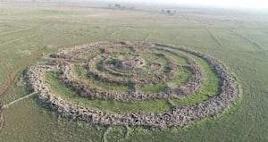

The newly discovered sites all share a similar design: large circular structures, between approximately 50 to 250 meters in diameter, built with stones taken from local basalt fields.
The stone circles of Rujm el-Hiri, nicknamed “Israel’s Stonehenge” or “Gilgal Refaim,” are not the only ones of its kind, according to a new study by Ben-Gurion University of the Negev (BGU) researchers.
By using advanced satellite imagery and remote sensing technology to survey areas previously inaccessible, BGU researchers have identified at least 28 other sites within 25 kilometers of Rujm el-Hiri that were not previously known.
The findings, recently published journal PLOS One, suggest that Rujm el-Hiri was not a singular, isolated monument, but rather an “elaborate example of a widespread architectural tradition integrated into the social and economic systems of the proto-historic Levant.”
Rujm el-Hiri was first discovered in the Golan Heights in 1968, and has been dated to approximately 3,500 and 6,500 years ago. It is made of a central cairn encircled by multiple concentric basalt stone rings, spanning for over 150 meters in diameter.
Satellite imagery revealed that the newly discovered sites share a similar design: large circular structures, between approximately 50 to 250 meters in diameter, built with stones taken from local basalt fieldstones.

Site part of a broader social, economic system
The discovered structures contain circular walls and internal partitions, often located near seasonal water sources and integrated into agricultural land use, revealing how ancient populations managed their resources and moved across the area.
Further, researchers believe the stone circles may have been multi-purpose, serving as ritual gathering places, territorial markers, or assembly sites for ancient herding communities, adding to earlier theories of Rujm el-Hiri being a burial site or astronomical observatory.
According to Dr. Michal Birkenfeld of BGU’s Department of Archaeology, the circles “invite a reinterpretation of significant proto-historic monuments in the region, recognizing them as integral parts of broader social and economic systems.”
"Our analysis may have implications for previous interpretations of Rujm el-Hiri's function," she concluded. "While traditional archaeological methods remain essential, this landscape-based perspective allows us to reach a fuller understanding of these monuments within our shared human past."
NEUESTE BEITRÄGE
- 1
 Energy agency chief warns of 'black April' for oil supplies07.04.2026
 - 2All the eclipses, supermoons, meteor showers and planets to spot in 202631.12.2025
- 3Architect Frank Gehry has died: See his most iconic buildings05.12.2025
- 4Amid growing bipartisan scrutiny of Pete Hegseth, Trump says he 'wouldn't have wanted … a second strike' on alleged Venezuelan drug boat survivors01.12.2025
- 5Gartex Texprocess India to showcase innovations across textile ecosystem27.03.2026




Ähnliche Artikel
- Unfathomable and Entertaining Legal disputes That Surprise everyone30.06.2023
- Lilly becomes first healthcare firm to join trillion-dollar club, Wall Street reacts21.11.2025
- Yemen's Houthis ready to join Iran war if needed, raising new shipping risk27.03.2026
- New movies to watch this weekend: See 'They Will Kill You' in theaters, rent 'Send Help,' stream 'Pretty Lethal' on Prime Video27.03.2026
- Here's how 'Bridgerton' fans can watch the first episode of Season 4 before its Netflix release later this month13.01.2026
- 7 Popular Vacation destinations In China06.06.2024
- Nuno Loureiro, MIT physicist, fatally shot at home; police investigate17.12.2025
- The Best Games On the planet07.07.2023
- 21 Things You Ought to Never Tell Your Childless Companion04.12.2015
- Nature's Treats: 10 Organic products That Lift Prosperity05.06.2024