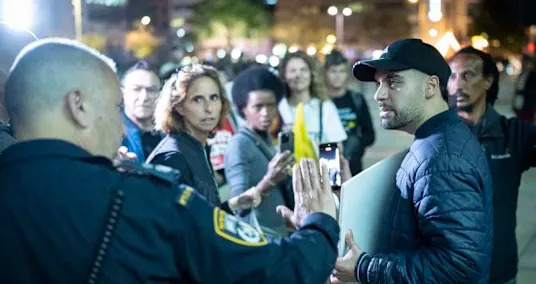
Protests took place in Tel Aviv, Jerusalem, Haifa, and Beersheba, as a survey found broad but uneven support among Jewish Israelis for Operation Roaring Lion.
Israel Police arrested 21 anti-war protesters Saturday night as demonstrations against the conflict with Iran expanded in multiple cities despite restrictions on public gatherings.
Protests took place in Tel Aviv, Jerusalem, Haifa, and Beersheba, with hundreds of participants reported in Tel Aviv and Jerusalem and about 100 in Haifa, marking the largest turnout since weekly demonstrations began. Authorities said 13 people were arrested in Tel Aviv and eight in Haifa.
Police said the gatherings were not approved under Home Front Command regulations that ban events with more than 50 people. Officials said the increase in turnout followed calls by groups opposing the government to protest despite the restrictions.
“During a situation assessment that took place at the scene with a Home Front Command representative… it was clarified that there was a real risk to human life and accordingly, Yarkon [precinct] police commander Tzachi Sharabi ordered the gathering to be dispersed,” police said.
Hadash-Ta’al chairman Ayman Odeh, an Arab lawmaker involved in the protests, criticized the police response, calling officers fascists “in the service of the government” and saying they were afraid of “the heroic citizens who went out, despite everything, to make their voice heard.”

Survey shows broad, uneven support for war
The demonstrations come as a March 2026 survey by the Israel Democracy Institute found broad but uneven support among Jewish Israelis for Operation Roaring Lion. Support was strongest on the Right at 87% and about half on the Left.
The survey also found that Jewish and Arab respondents largely agreed that Iran’s resilience has been stronger than expected. Most Jewish respondents said Israeli society could sustain the campaign for up to one month, while 28% said as long as needed. Arab respondents were less optimistic about how long the public could endure the conflict.
A majority of Jewish respondents said Prime Minister Benjamin Netanyahu’s decision was driven by security considerations, while most Arab respondents viewed it as political.
NEUESTE BEITRÄGE
- 1
 Australia to offer businesses $693 million in cheap loans to ease fuel cost pressure01.04.2026
 - 2Merz: 80% of Syrians in Germany should return in three years30.03.2026
- 3'Fertiliser costs mean I'm better off not planting'30.03.2026
- 4The Artemis II launch is tonight. Here's how to watch it live.01.04.2026
- 5Lebanon’s Hezbollah and Yemen’s Houthis join Iran in strike on Israel06.04.2026


Ähnliche Artikel
- Ukraine demands army of 800,000 under peace plan11.12.2025
- No red, no long shorts: The fashion rules Joe Burrows lives by08.12.2025
- How much would you pay to meet a Real Housewife? At BravoCon, the limit does not exist.21.11.2025
- New portrait of the oldest-known supernova | Space photo of the day for March 27, 202627.03.2026
- Overseeing Individual budgets Successfully06.06.2024
- The Secret Side of Italy: 12 Underrated Destinations Locals Don’t Want Tourists to Find24.11.2025
- How a seabird native to Hawaii has adapted to life in Honolulu's concrete jungle01.04.2026
- The 3 little words TV fans can't stop obsessing over02.04.2026
- Polls open in tense Uganda election amid widespread delays14.01.2026
- $1,000 bribes, Mormon momfluencer mixers and making content to get plastic surgery: The wildest things I learned reporting my book02.04.2026