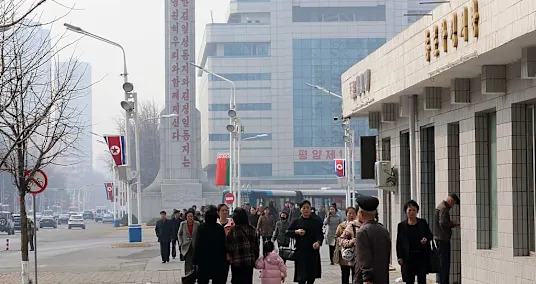
China has announced that its flag carrier, Air China, will resume direct flights to North Korea after a six-year pause, following the restoration of passenger train services between Beijing and Pyongyang.
This marks a significant step toward reopening North Korea, one of the world's most isolated nations, to the world.
Transport links between the two capitals had been suspended since the start of the Covid-19 pandemic in 2020, when Pyongyang implemented a very strict border closure.
While North Korean carrier Air Koryo already resumed flights to Beijing in 2023 and allowed Russian tour groups to visit in 2024, the return of China's air and railways are seen as a major economic milestone, as China has for decades been the main trading partner and a key source of diplomatic and economic backing for the country of 26 million people.
Before the pandemic, there were an estimated 300,000 foreign visitors in 2019, according to South Korea's Institute for International Economic Policy, and Chinese visitors accounted for 90% of all tourists to North Korea. Therefore, the long delay in resuming regular travel had surprised many regional observers.
"The reopening of these borders has been driven primarily by Pyongyang's timeline, which challenges the outdated assumption that Beijing dictates terms to a dependent client state," Seong-Hyon Lee, a visiting scholar at the Harvard University Asia Centre, explains.
Related
Nuclear ambitions complicated the relationship
Despite being Pyongyang’s primary ally, Beijing has frequently voiced disapproval over the North's persistent missile tests and nuclear ambitions. This aspect created a bumpy relationship with Pyongyang, with analysts saying that a nuclear-armed North Korea has often been something of a liability.
The diplomatic normalisation was highlighted last September, when Kim Jong Un attended a massive military parade in Beijing alongside Russian President Vladimir Putin. This was Kim's first appearance at a Chinese military display.
Lim Eul-chul, a North Korea expert at South Korea's Kyungnam University, argues that the war in Iran, in particular, increased "the need for closer coordination between the two nations".
NEUESTE BEITRÄGE
- 1
 Shooting of MIT professor Nuno Loureiro has police searching for a suspect17.12.2025
 - 2How a Middle East War Becomes a Retail Price Hike26.03.2026
- 3NASA's Apollo 8 moonshot saved 1968. Could Artemis 2 do the same in 2026?24.12.2025
- 4Cocaine, caffeine, painkillers consumed by sharks in Bahamas, study finds26.03.2026
- 54 Energy-Proficient Clothes washers to Consider in 202405.06.2024





Ähnliche Artikel
- HGV driver recruited others to smuggle migrants30.03.2026
- Ringleader of suspected human trafficking network arrested in Ethiopia07.04.2026
- The race to mine the moon is on – and it urgently needs some clear international rules31.12.2025
- Guinea-Bissau's coup called a 'sham' by West African political figures28.11.2025
- Japan deploys the military to counter a surge in bear attacks05.11.2025
- Old photos misrepresented as aftermath of political party supporters' brawl in Bangladesh12.11.2025
- The Secret Side of Italy: 12 Underrated Destinations Locals Don’t Want Tourists to Find24.11.2025
- Beating Scholastic Difficulties: Understudy Examples of overcoming adversity25.09.2023
- From Loner to Force to be reckoned with: Individual Accounts of Change22.09.2023
- Relentless rise in carbon pollution from fossil fuels slightly dampens climate-fighting hopes12.11.2025